

The short answer
Replace the split tech pack workflow—not the design judgment.
Excel and Illustrator can make a tech pack. The problem is rebuilding the same pack by hand—flats in one file, points of measure and materials in another, then another PDF every time the style changes. AI Tech Packs moves that assembly loop into one editable working pack: generate a draft from an image, review the production details, then export or share the approved result.
Keep Illustrator for original vector design when it is the right tool. Keep human technical review for measurements, grading, fit, sampling, and factory decisions. The software replaces repeated pack assembly—not the people responsible for the product.
Start with a draft. Review every critical detail before factory handoff. Export options depend on plan.
Operator comparison
Excel + Illustrator vs AI Tech Packs
The useful comparison is not whether all three tools can produce a document. It is where the team spends time, how revisions move, and which decisions still require a production owner.
Swipe the table to compare columns →
| Task | Excel + Illustrator workflow | AI Tech Packs workflow | What stays human |
|---|---|---|---|
| Original design work | Create and refine vector artwork in Illustrator; Excel is not involved. | Start from a design image, flat, or garment photo. Keep Illustrator for original vector design when you need it. | Design intent, artwork, and final visual decisions. |
| Flat sketches | Draw or redraw flats in Illustrator and carry changes into the specification. | Generate a first-draft flat from the reference image, then review it before handoff. | Silhouette, construction lines, and garment details. |
| POMs and size charts | Build and copy measurement tables in Excel, then reconcile them with the flat. | Draft points of measure and an editable size structure in the working pack. | Base measurements, grading, tolerances, fit, and sampling. |
| Materials and components | Enter BOM rows manually and check that codes and callouts match the design file. | Draft structured materials and component rows for the team to complete and approve. | Composition, supplier details, consumption, costing, and compliance. |
| Working revisions | Coordinate Illustrator files, spreadsheets, exported PDFs, and email attachments. | Edit the saved working pack and share the current factory-facing view when it is ready. | Release approval and confirmation that the factory has the intended pack. |
| Factory handoff | Package and email multiple static files, then explain which attachment is current. | Export PDF or Excel; Designer teams can also send a current Factory Share link. | Factory questions, feasibility, sampling feedback, and production decisions. |
| Collection pace | Copy the last pack and rebuild the same structure style by style. | Designer teams can generate and review up to 10 styles in one batch. | Style-by-style review before anything reaches a factory. |
| Time profile | Start with blank or copied files and repeat setup, formatting, and cross-checking. | Create the first draft in minutes; review time varies with garment complexity and source quality. | There is no responsible shortcut around technical review. |
Product scope checked July 2026 against AI Tech Packs pages for generation, editing, Excel export, and Factory Share. Confirm current plan details before purchasing.
Product proof
From editable pack to factory output
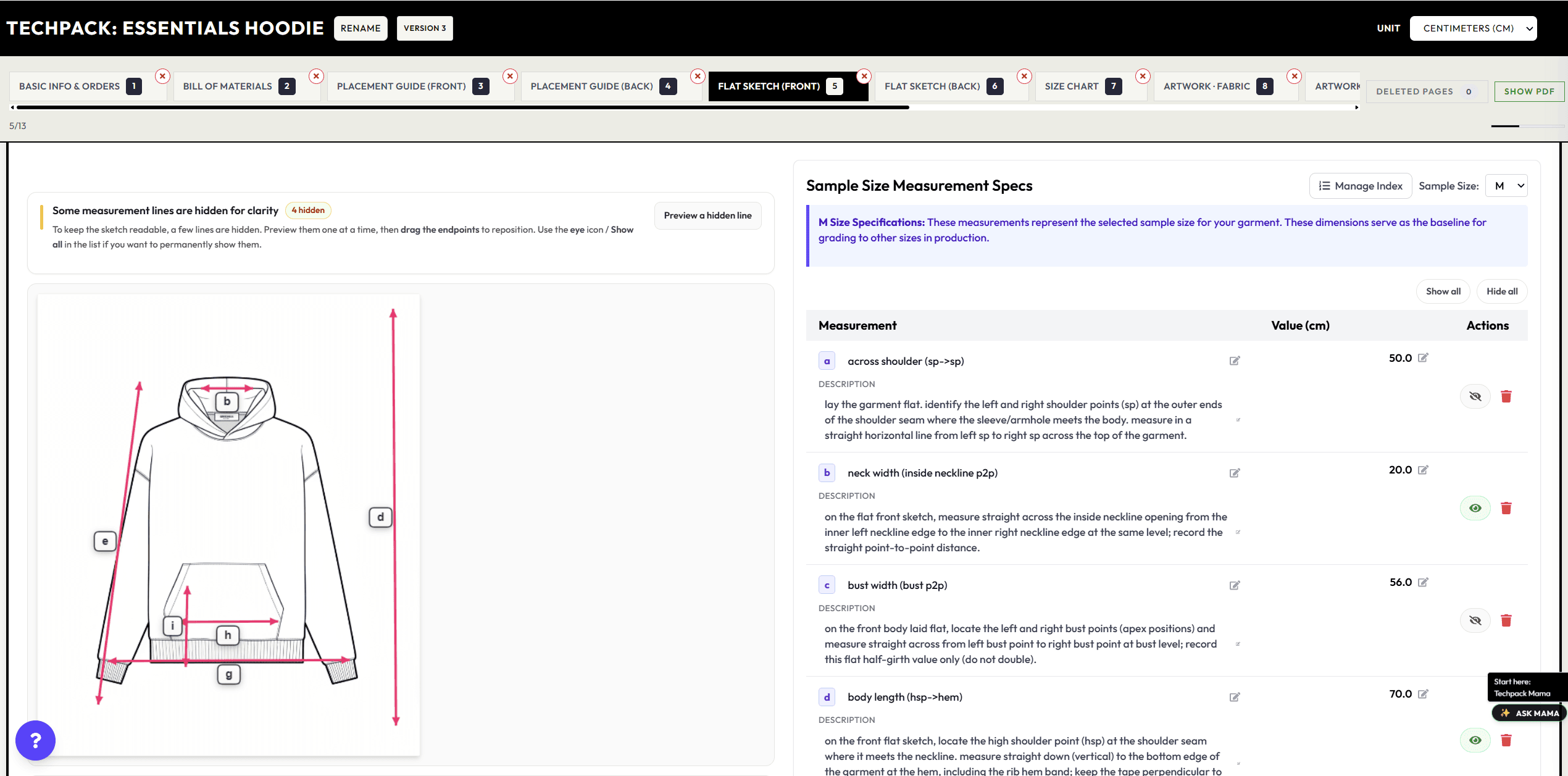
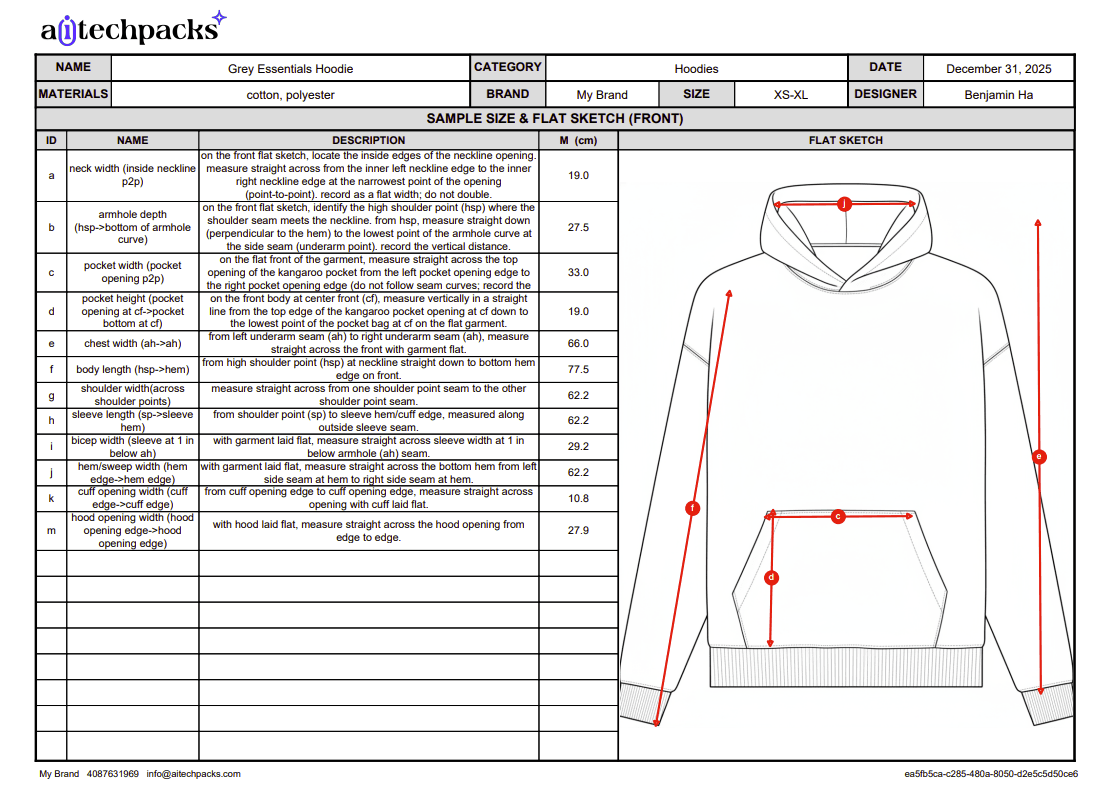
The working draft and the handoff are two different states. Your team edits the structured pack first; the factory receives the reviewed PDF, Excel workbook, or current share view.
01
Start with the final design direction
Upload a garment image, sketch, or flat once the style is clear enough to specify.
02
Generate the working draft
AI drafts flats, measurements, materials, and construction details instead of leaving a blank template.
03
Run technical review
A designer or production owner checks fit-critical data, grading, tolerances, components, artwork, and notes.
04
Export or share the approved pack
Send PDF or Excel output, or use a current Factory Share link on the Designer plan.
If you work in apparel, you know the drill. Your creative process is split between two worlds: the visual canvas of Adobe Illustrator and the rigid data grid of Microsoft Excel. A brilliant garment design is born, only to be painstakingly deconstructed and manually re-entered into spreadsheets. This cycle of copy-pasting, data entry, and file management is not just tedious—it’s where costly mistakes are born.
For years, this disjointed workflow was simply the cost of doing business. But as we move through 2026, relying on general-purpose software for the highly specialized task of tech pack creation is a significant competitive disadvantage. Your brand is likely searching for tools that replace Excel and Illustrator for fashion tech pack creation because the old way is too slow, too risky, and too expensive.
The True Cost of the Excel & Illustrator Workflow
This broken system isn't just an inconvenience; it's a source of constant friction that introduces risk, stalls your development calendar, and silently drains your budget. The hidden costs of this outdated process directly limit your brand's ability to scale.
The High Cost of Manual Errors
A single typo in an Excel measurement chart or a wrong material code in your Bill of Materials (BOM) can quietly sabotage an entire production run. This one simple mistake can lead to rejected samples, wasted materials, and thousands of dollars lost.
This manual process also creates the version control nightmare every production manager dreads. When your factory receives a file named T-Shirt_TechPack_V5_FINAL_use_this_one.pdf, how can you be certain they are working from the correct information? This confusion is a leading cause of production errors, all stemming from the lack of a single source of truth for your tech pack.
Disconnected Workflows Kill Speed and Collaboration
The gap between a visual design in Illustrator and a data-driven spec in Excel is where speed and collaboration go to die. Your designer thinks in vectors and layers, while your production manager lives in component codes and measurement tables. The time and effort spent translating information between these two worlds creates a "translation tax" on every single style you develop.
This constant back-and-forth makes feedback loops painfully slow and effective collaboration nearly impossible. For production to run smoothly, your tech pack must serve as a clear, unambiguous blueprint for your factory [1], a goal that’s difficult to reach when critical data is scattered across different file types and email chains.
A Time Sink for Creative and Technical Teams
Consider the hours your team spends on repetitive, low-value administrative tasks:
- Manually building and formatting spec sheets in Excel.
- Painstakingly re-drawing flat sketches for every minor design revision.
- Endlessly cross-referencing spreadsheets with design files to check for consistency.
This isn't product development; it's high-stakes clerical work that pulls your talented team away from designing, innovating, and growing the brand [2]. Even with powerful cloth design apps, the entire process grinds to a halt at the tech pack stage.
The AI-Powered Solution: Build Specs in Minutes, Not Days
Why continue to fight with tools that were never built for the apparel industry? AI Tech Packs is the purpose-built, intelligent platform designed to replace the clunky Excel and Illustrator combination. It transforms a process that takes hours—or even days—into one that you can complete in minutes.
From a Single Photo to a Full Tech Pack
Here is where your workflow is completely revolutionized. Simply upload a design image—it can be a sketch, a render, or even a photo from your phone—and our AI generates a comprehensive, factory-ready tech pack. In minutes, you receive:
- Professional flat sketches with front, back, and side views.
- A complete Point of Measure (POM) chart with AI-suggested specifications.
- A structured Bill of Materials (BOM), ready for you to add your components.

Quick heads up: AI Tech Packs creates a dynamic, fully editable excel sheet, not just a static PDF. You maintain 100% control to refine and approve every detail.
This fundamentally accelerates your development timeline, allowing you to go from an idea to a complete specification faster than ever before. You can explore the AI tech pack generator to see how it works.
A Single Source of Truth for Your Entire Team
Say goodbye to confusing email threads and folders filled with outdated PDFs. With AI Tech Packs, your entire team—from designers and product developers to your factory partners—works from the exact same live document.
Updates are reflected in real-time for everyone. All comments, feedback, and approvals are tracked in one centralized hub. This simple shift eliminates version control errors and guarantees your manufacturer is always referencing the latest, most accurate tech pack.
Eliminate Errors with AI-Powered Consistency
Human error is an unavoidable part of manual data entry. AI-powered automation is the solution. AI Tech Packs intelligently populates your BOM, suggests standardized measurements based on your garment type, and ensures every section of your spec sheet is complete and consistent. This proactive approach builds accuracy into your process from the very first step. You can see exactly how to build a professional AI tech pack and watch how the AI assists you at every stage.
Side-by-Side: The Old Way vs. The AI Tech Packs Way
The difference isn't just an incremental improvement; it's a complete transformation of your workflow. This direct comparison makes the choice clear.
Feature / Task
The Old Way (Excel + Illustrator)
The AI Tech Packs Way
Flat Sketch Creation
Manual drawing; time-consuming to edit.
AI-generated from a photo; instantly editable.
BOM Creation
Manual data entry; high risk of typos.
AI-assisted population; linked to your material library.
Measurement Specs
Manual creation of tables; prone to errors.
AI-suggested POMs; easy to adjust and grade.
Version Control
Confusing file names; risk of using old versions.
Centralized platform; a single, live source of truth.
Factory Communication
Emailing multiple, large, static files.
Sharing a single web link; real-time updates.
Time to Completion
Hours or Days
Minutes
Conclusion: Stop Fighting Your Tools, Start Scaling Your Brand
Excel and Illustrator are powerful programs, but they are simply not the right tools for fashion tech pack creation. Continuing to force them into this role is a choice to accept inefficiency, risk, and slow development cycles that hold your business back.
By switching to a purpose-built platform like AI Tech Packs, you streamline the entire garment manufacturing process from the very beginning. You empower your team to operate with speed and precision, eliminating costly mistakes and freeing them to focus on what truly matters: designing incredible products and growing your brand.
Ready to build tech packs 10x faster and eliminate costly errors? Book a free demo of AI Techpacks and see how you can go from photo to factory-ready in minutes.
Meta Description
Tired of using Excel & Illustrator for tech packs? Discover how AI tools replace them, letting you build complete, error-free fashion specs in minutes.
Citations
- [1] https://supplyscope.io/how-to-design-a-good-tech-pack
- [2] https://manufacturer.clothing/how-to-make-a-tech-pack
A practical test
Test the switch with one real style.
Use a style your team already understands. Compare the draft, review effort, export, and factory handoff with your current process before changing the rest of your workflow.


